
LoadBuilder and LoadPlanner Solutions Overview
LoadBuilder and LoadPlanner are purpose-built, cloud-native truck building and load planning solutions designed for foodservice and grocery distributors to optimize outbound operations from warehouse picking to delivery, offering significant reductions in load planning hours, warehouse trips, loading hours, and delivery time per stop, with LoadBuilder suited for small to midsize businesses needing pallet composition and load planning in one system, and LoadPlanner tailored for complex large enterprise operations.
LoadBUILDer & LoadPLANNer
Optimize the Full Outbound Operation, Not Just the Truck.
Purpose-built truck building and load planning solutions for foodservice and grocery distributors. From the warehouse pick to the last delivery stop.
Request a Demo Take a Tour Download Datasheet
50-75%
Reduction Hours Building Load Plans
10%
Reduction Selector Trips Through Warehouse
20-50%
Reduction Loading Hours
5-10%
Reduction Delivery Time Per Stop

Choose Your Solution
LoadBuilder or LoadPlanner?
Two products built for different operational profiles. The right fit depends on how your operation manages pallet composition today.

One Product, One Decision
Small and Midsize Business to Enterprise
LoadBuilder owns pallet composition AND load planning — one product, one decision. Cloud-native and WMS-agnostic, it’s the right fit when your WMS doesn’t build pallets, builds them poorly, or when you want a single outbound system regardless of your current stack.
✓
Your current WMS or ERP doesn't manage pallet composition
✓
You're building pallets manually or through tribal knowledge today
✓
You need a WMS-agnostic, purpose-built food distribution solution
✓
You want to future-proof across small and midsize business to enterprise scale

Outbound Optimization for Complex Enterprise Stacks
For Large Enterprise Operations With Mature Existing Systems
Your WMS already generates and builds the pallets. You need a smarter way to put them on the truck. LoadPlanner slots into your existing WMS, routing, and ERP stack with minimal change management as an outbound efficiency optimizer.
✓
Large enterprise distributor with an established WMS generating pallets
✓
Your existing system handles selection but not optimal truck placement
✓
Deep integration with current ERP or routing stack is a requirement
✓
You need a purpose-built food distribution add-on
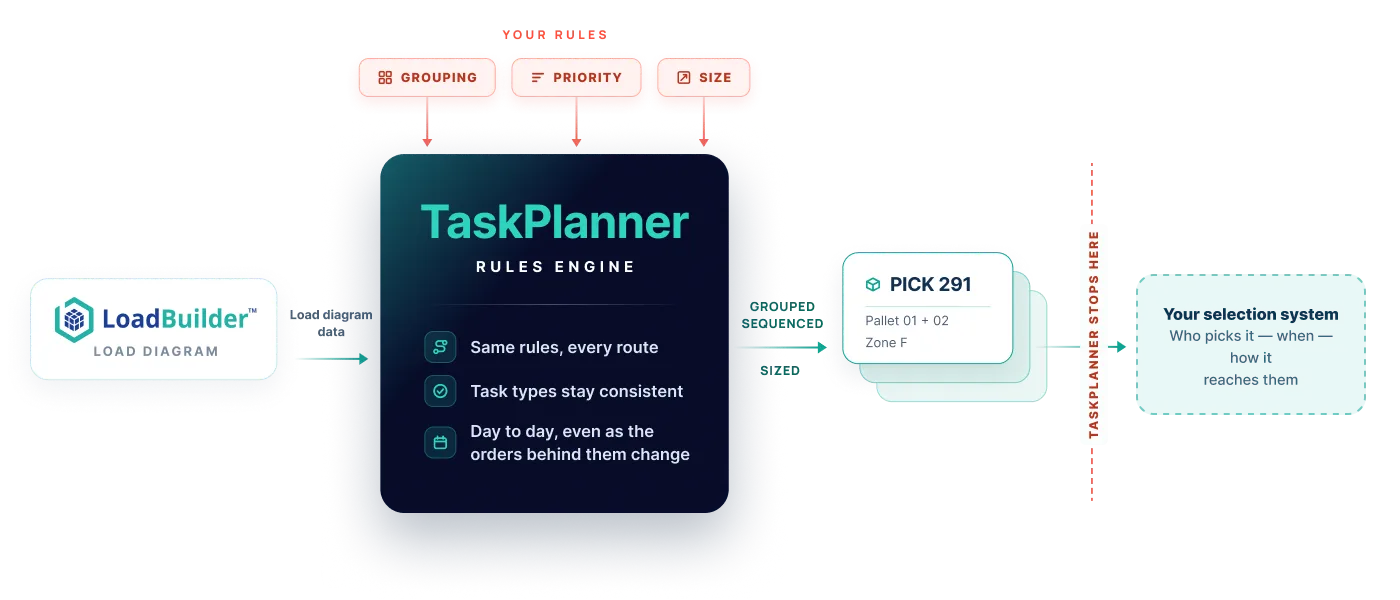
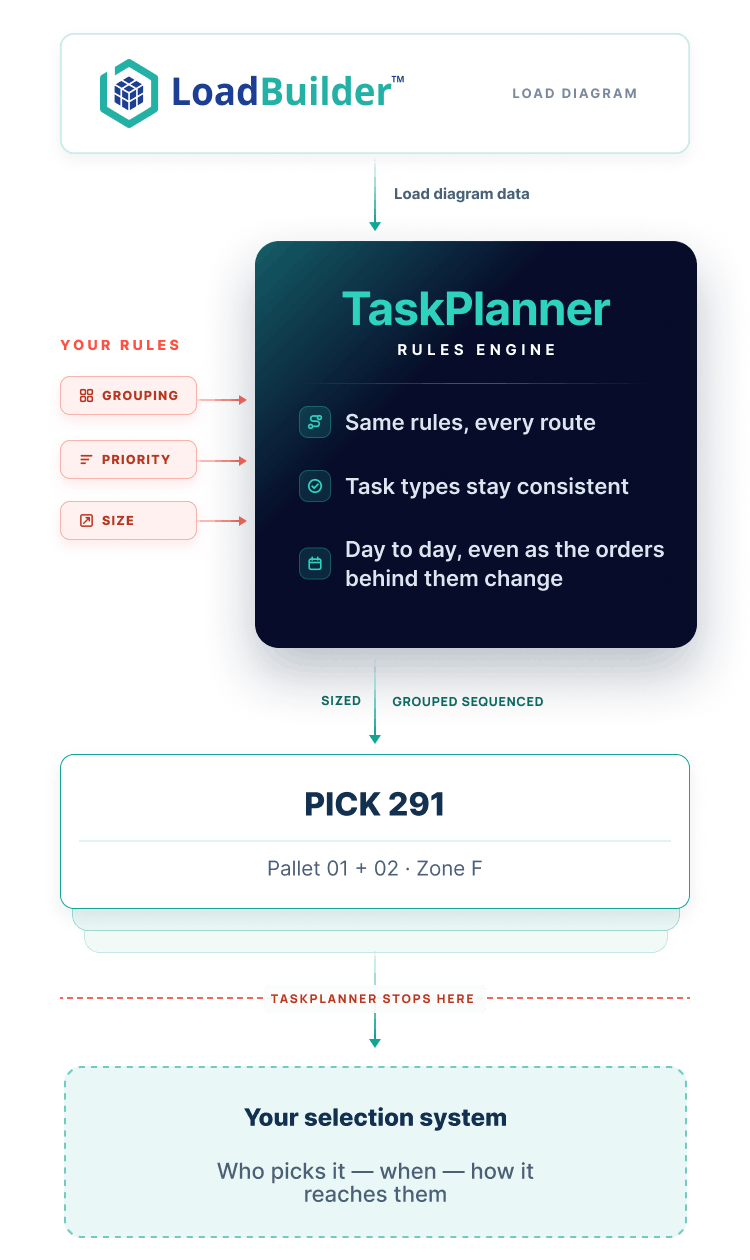
TaskPlanner™ turns your load diagram into ready-to-run tasks
LoadBuilder already builds your load. TaskPlanner is available as a built-in option that takes it a step further, applying the grouping, priority, and size rules your operation runs by to turn that load diagram into tasks: sets of work sized and sequenced the way your crew operates. Your selection system takes it from there.
Take a Tour
Tourial
GET IN TOUCH
Welcome to a self-guided tour of LoadBuilder™.
Let's get started! Click through this short demo using the directions and buttons on the screen.
Start Demo

reCAPTCHA
Recaptcha requires verification.
protected by reCAPTCHA
Why LoadBUILDER or LoadPLANNer
The Triggers That Bring Distributors to Us
Most distributors come to BFC for one of four reasons. Recognizing yours helps us move faster to demonstrate value.
Your WMS or ERP Wasn't Built for Food Distribution
Generic platforms handle inventory. They don't optimize pallet composition, temperature zones, axle weights, or FILO sequencing. That gap lives in tribal knowledge and manual workarounds.
Tribal Knowledge Is a Business Risk
When your best loaders retire or leave, operational performance walks out with them. BFC converts institutional knowledge into rule-based, repeatable processes that any team member can execute.
Labor Costs Are Compressing Margins
Inefficient routes, missed stops, and overtime on the dock floor add up fast. BFC customers consistently move more cases with the same or fewer trucks, directly improving cost per delivery.
OTIF and Compliance Pressure Is Intensifying
Retail and foodservice customers are tightening on-time, in-full requirements. Regulatory audits have less tolerance for documentation gaps. BFC makes compliance a built-in output, not an afterthought.
Key capabilities
What BFC Does That Others Can't
Six capability areas purpose-built for the complexity of food distribution, from dock to delivery.
Temperature Zone Management
Automatically enforce product separation rules across frozen, refrigerated, and ambient zones within every load, maintaining regulatory compliance and product integrity on every truck.

Axle Weight & Load Balance
Simulate weight distribution across 20,000+ truck configurations to maintain legal axle limits and safe load balance, protecting your drivers, equipment, and DOT compliance record.
FILO Sequencing & Stacking Rules
First-in, last-out optimization ensures the right product is accessible at each stop. Dynamic stacking rules prevent damage and reduce handling time at every delivery point.
WMS & ERP Integration
Cloud-based and WMS-agnostic. BFC connects to your existing systems with minimal change management, enhancing what you have rather than replacing it.
Dynamic Bulkhead Optimization
Automatically adjust compartmentalization for each load configuration, maximizing truck utilization while respecting product compatibility and delivery sequence requirements.
Truck Map Guide
A visual overhead map of the planned truck, showing every pallet position, stop assignment, and zone placement so planners can verify the load is right before a single case moves.
The business case
Documented ROI Across Three Dimensions
The business case for LoadBuilder and LoadPlanner runs across labor, compliance, and delivery performance. Results vary by operation size and baseline. Your discovery call will include a baseline assessment.
Performance Area
Metric
Typical Outcome
Mechanism
Delivery Efficiency
15–20% more cases per stop
Higher revenue per route
Optimized sequencing and load density
Loading Accuracy
~30% fewer loading errors
Reduced claims, rework, and customer complaints
Rule-based placement eliminates manual judgment
Regulatory Compliance
99%+ compliance rate
Audit-ready documentation on every load
Temperature, weight, and separation rules automated
Load Planning Speed
3x faster planning cycles
Earlier departure times, less overtime
20,000+ layout simulations replace manual decisions
Truck Utilization
Measurable capacity increase
More cases moved with same fleet
Dynamic bulkhead optimization and stacking rules
How it works
From Order to Departure, Optimized
Both products transform the same workflow. Where they plug in depends on where pallet composition is decided.
End-to-End Workflow
1
Routed Sales Order Intake
Routed customer orders flow into LoadBuilder from your OMS or ERP. No WMS required, just pick sequence information.
2
Pallet Composition
LoadBuilder determines optimal pallet contents, applying product compatibility, weight, and temperature rules.
3
Warehouse Selection
Items are selected and pallets are built based on guidance from LoadBuilder, utilizing your existing picking process, and staged for loading.
4
Truck Load Optimization
Pallets are placed on the truck in optimal sequence: FILO, weight balance, zone compliance enforced automatically.
5
Load Sheet & Documentation
Dock team receives a complete, rule-verified load sheet. Compliance documentation generated automatically.
Integration Workflow
1
WMS Generates Pallets
Your existing WMS handles selection and pallet composition as it does today. No change to upstream processes.
2
Pallet Data Feeds LoadPlanner
Completed pallet data (dimensions, weight, contents, temperature zone) passes to LoadPlanner via integration.
3
Optimal Truck Placement
LoadPlanner determines the ideal placement for every pallet: FILO sequence, axle balance, zone compliance, stacking rules.
4
Load Sheet Delivery
Dock team receives LoadPlanner's optimized load sequence: clear, rule-verified, immediately actionable.
Who it's for
Built for Every Role in the Operation
Food distributors running complex warehouse and delivery operations. Here's what each decision-maker gains and what they need to show their leadership team.
Transportation & Logistics
VP Transportation / Director of Transportation
✓
Eliminate hours of manual load building per route
✓
Enforce axle weight compliance before trucks reach the scale
✓
Reduce cost-per-case through improved cube utilization
✓
Improve OTIF by delivering in stop sequence every time
✓
Standardize load plans consistently across every DC
Owns cost-per-case, fleet utilization, OTIF metrics, and DOT compliance. Wants the data to prove the operation is running right.
Warehouse & Operations
VP Warehouse / DC Operations
✓
Give loaders a clear sequence instead of judgment calls
✓
Reduce loading errors, product damage, and rework
✓
Cut truck build time without adding headcount
✓
Enforce temperature zone and stacking rules automatically
✓
Build consistent process across every loader and every shift
✓
Reduce overtime and dock congestion through faster, more predictable load cycles
✓
Give load planners a visual confirmation tool that reduces errors before work begins
Owns dock-to-door productivity and throughput. Needs throughput gains without proportional headcount growth.
IT
CIO / VP of IT
✓
Cloud-based, WMS-agnostic architecture with minimal integration lift
✓
Fast time to value with low change management overhead
✓
Full audit trail and data integrity built into every load
✓
No rip-and-replace required; BFC layers onto existing systems
✓
Predictable, well-documented API integrations with major WMS and ERP platforms
Owns system architecture, integration complexity, and data governance. Needs a solution that fits the stack without creating new technical debt.
The BFC Differentiator
Connect the Full Chain
Most platforms optimize one link in the chain. As a cloud-based platform purpose-built for food distribution, we connect pick-to-load-to-delivery, so inefficiencies don't just shift from one step to another. The result is measurable improvement across the entire outbound operation.

Build
Pallet Composition
Product grouped by zone, weight, and stop sequence.

Load
Truck Optimization
Axle balance, FILO sequencing, and compliance enforced.
Deliver
On-Time, In-Full
Every stop unloads cleanly. OTIF requirements met.
Competitive Landscape
What Load-Building Platforms Don’t Tell You They’re Missing
The market talks about trailer utilization and transportation cost reduction. That's table stakes. Here's where generic load-building platforms, optimized for freight and not food, stop short.
Capability
BFC Food Ops Platform
Generic WMS / ERP
Purpose-built for food distribution
✓
15–20% more cases per stop
✕
Generic freight or warehouse logic
Multi-temperature zone (frozen/chilled/dry)
✓
Purpose-built for food service
✕
Generic freight logic only
Pre-pick pallet assignment (before selection)
✓
Decision before pick release
✕
Post-pick load adjustment only
Re-palletization labor elimination
✓
Root cause removed upstream
✕
Not on the roadmap
Driver delivery sequence optimization
✓
Core differentiator; stop-aware loading
✕
Stops at the trailer door
Designed For
Broadline Distribution
Mixed-temperature, high-SKU complexity with multiple stops per route and FILO requirements.
Meat & Seafood
Temperature-critical loads with strict zone separation and chain of custody documentation.
Produce
High-velocity perishable operations with tight delivery windows and damage sensitivity.
Multi-Truck Operations
Fleet operators managing consistent load quality and compliance across multiple vehicles and shifts.
LoadPlanner & LoadBuilder
See What Load Optimization Does For Your Operation
More cases per route. Fewer loading errors. Trucks that leave right the first time, every time. BFC customers see measurable improvement across labor, compliance, and delivery performance. Talk to an expert and find out what that looks like for your trucks.