
Nappies Food Service: Warehouse Transformation with Dakota WMS
Nappies Food Service transformed its decades-old, paper-based warehouse operations by implementing Dakota WMS, resulting in a 35% productivity increase, 20% reduction in warehouse footprint, avoidance of a $6 million expansion, reduction from three to two staffing shifts, improved truck readiness, real-time inventory visibility, and a culture of data-driven ownership, all while streamlining high-volume nightly shipments and reducing manual handling and overtime pressures.
CUSTOMER SUCCESS STORY
— NAPPIES FOOD SERVICE
From Planned Expansion To Doing More With Less
After years of paper-based warehouse operations and a layout shaped by decades of growth, Nappies Food Service used Dakota WMS to increase productivity, reduce its operating footprint, improve truck readiness, and build a more data-driven operation.
Download Case Study\ \ Download Case Study
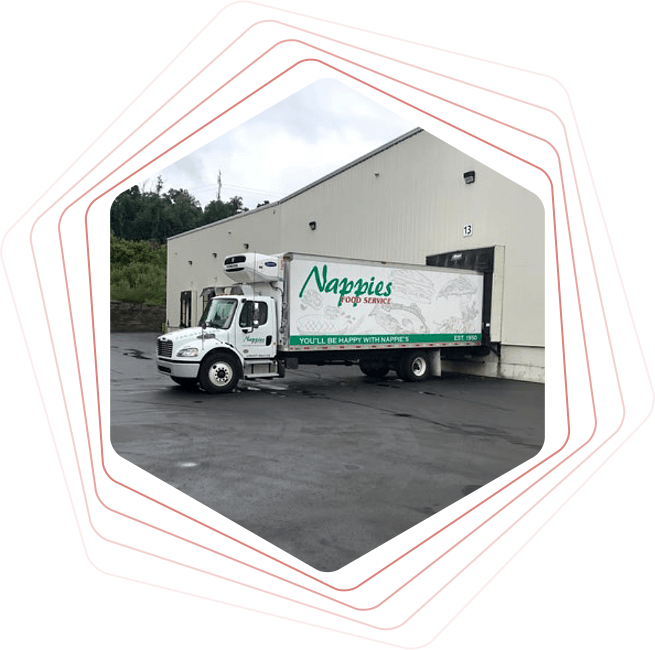
35%
Productivity Increase
Significant improvement in picking speed and warehouse operational efficiency.
20%
Footprint Reduced
Warehouse footprint effectively reduced through optimized space utilization.
$6M
Avoided Expansion
Successfully avoided a planned warehouse expansion and associated costs.
3 to 2
Staffing Reduced
Eliminated one full shift and stabilized a leaner warehouse labor model.
Truck Readiness
Improved truck readiness and reduced overtime through streamlined dispatch and better outbound flow.
Inventory Visibility
Enabled real-time inventory visibility to support sustainable growth and operational control.
Ownership Culture
Created distributed ownership through super users and data-driven decision-making.
THE CHALLENGE
The warehouse was working. The process was not scaling.
Nappies was shipping approximately 15,000 cases a night using pen and paper. Product was staged throughout the warehouse, cooler, and freezer, and third-shift teams often had to deconstruct and rebuild loads to match invoices and trucks.
Before Dakota WMS
!
Manual, paper-based picking across high-volume nightly operations
!
Product staged wherever space could be found in dry, cooler, and freezer areas
!
Cases touched four or five times before leaving the building
!
Truck stacking, pallet rework, and overtime pressure
!
Heavy dependence on tribal knowledge and limited system visibility
“
The ability to scan and reduce mispicks is great — but that’s not even the biggest benefit. We shrunk our warehouse. That’s crazy.
Nick Napoleone, CEO, Nappies Food Service
WHY NOW
Growth exposed the limits of brute-force warehouse operations.
Nappies had grown significantly, but the warehouse still reflected years of expansion rather than a deliberately engineered operation. Dry aisles had dead ends, travel paths were inefficient, and valuable cooler and freezer space was being used for staging instead of storage.
A strategic pause before expansion
✓
Nappies was preparing for a 70,000-square-foot warehouse expansion
✓
Leadership decided not to expand until the WMS was in place
✓
Dakota WMS gave the team the data to measure the operation properly
✓
After implementation and slotting optimization, Nappies realized it could operate in significantly less space
“
We went from planning a major expansion to realizing we could do more with less — and that changed our entire approach.
Nappies Food Service Leadership Team
WHY DAKOTA WMS
More than scanning. A true warehouse management system.
Nappies initially thought they needed scanning. Through site visits, due diligence, and peer conversations, the team realized the larger need was a full WMS with operational intelligence, real-time inventory visibility, and long-term scalability.
Why Dakota stood out
- Comprehensive WMS, not just a picking solution
- Real-time inventory visibility
- Support for cubes, weights, velocities, and slot types
- Strong inbound and outbound operational control
- Cloud-based architecture and long-term scalability
The operational need
- Visibility into inventory and warehouse flow
- Reduction in touches, rework, and manual staging
- Better truck readiness and dispatch consistency
- Smarter slotting and space utilization
- A scalable foundation for growth and acquisitions
Legacy warehouse flow
- Dead-end aisles and inefficient travel paths.
- Dry, cooler, and freezer staging spread throughout the facility.
- Loads rebuilt to match invoices and trucks.
- Auditing depended heavily on experienced employees.
System-driven operation
- Racetrack warehouse flow and improved travel patterns.
- Optimized slotting and better use of cooler/freezer capacity.
- Real-time validation to prevent errors before they become costly.
- Analytics guiding daily slotting, replenishment, and labor decisions.
Financial impact
Avoided expansion with a tighter, faster warehouse.
Dakota WMS helped Nappies convert warehouse redesign, slotting optimization, reduced touches, and better visibility into measurable operational and capital-impact results.
$6M
Planned warehouse expansion avoided after Nappies optimized space, reduced staging requirements, and improved how the existing building was used.
20%
Effective footprint reduction
Freed capacity by eliminating staging areas, optimizing slot sizes, and aligning space with velocity.
35%
Productivity increase
Driven by better slotting, racetrack flow, riding jacks, reduced touches, and data-backed optimization.
3→2
Shift structure improved
Nappies consolidated from three warehouse shifts to two and reduced overtime pressure.
IMPLEMENTATION
Implementation Expertise That Guided the Transformation
Nappies partnered closely with the BFC project team throughout the implementation process. Beyond software deployment, the team provided operational guidance around warehouse flow, slotting strategy, best practices, change management, and go-live execution — helping Nappies build a more scalable, system-driven operation.
1
Warehouse reconfigured
Nappies transformed dead-end aisles into a more efficient racetrack layout, rebuilt racking, re-slotted product, and added rack and location labels.
2
Inbound go-live
Inbound launched in September 2024 after Labor Day, on one of the heaviest inbound days in company history with more than 22,000 received cases.
3
Outbound go-live
Outbound launched in January 2025 with a new shift structure and continued process stabilization.
4
Ownership model built
Nappies created micro-super users for slot optimization, new product setup, replenishment, TruckBuilder®, productivity, mispicks, and labor performance.
OUTBOUND OPTIMIZATION
TruckBuilder® improved dispatch readiness and driver confidence.
Before Dakota WMS, trucks were stacked manually, product was touched repeatedly, and builds depended on experienced employees. With Dakota WMS and TruckBuilder®, loads are organized earlier, labels clearly identify product and stop information, and new drivers can load with more confidence.
Faster
Driver loading and simpler route preparation
Less
Waiting time, damage, rework, and mispicks
WAREHOUSE TRANSFORMATION
Nappies moved from experience-driven execution to data-driven control.
Dakota WMS gave Nappies the visibility to manage slotting, replenishment, inventory movement, labor performance, and truck readiness with intent — while creating a more scalable foundation for growth.
Operational gains
✓
Reduced warehouse footprint and freed cooler/freezer capacity
✓
Higher productivity through better flow, slotting, and reduced touches
✓
Improved truck readiness and reduced overtime pressure
✓
Real-time validation helped prevent errors before they became returns or waste
✓
Inventory visibility supported growth beyond the core warehouse
Cultural impact
✓
Analytics became part of the daily operating rhythm
✓
Super users created distributed ownership across functions
✓
Teams shifted from patchwork fixes to root-cause process discipline
✓
Employees became power users and internal champions
✓
Leadership gained confidence to support growth, including acquisition activity