
Troubleshooting Inefficient Pallet Builds for Frozen and Fresh Food
The article explains that inefficient or non-compliant pallet builds for frozen and fresh food often stem from inaccurate WMS master data, optimization algorithms that prioritize space over stability, and a disconnect between real-world warehouse conditions and system logic, emphasizing that accurate case data, temperature-zone rules, and proper configuration are essential to resolving issues like unstable pallets, mixed temperature zones, and wasted trailer space in cold-chain logistics.
Transportation
September 1, 2026
Troubleshooting Inefficient Pallet Builds for Frozen and Fresh Food


Published By
BFC Insights Team
Does your load planner/truck builder generate inefficient or non-compliant pallet builds for frozen and fresh food?
If your organization is seeing repeatedly inefficient or non-compliant pallet builds for frozen and fresh products, it can be frustrating—and expensive. Problems like unstable pallets, mixed temperature zones, out-of-compliance builds, or wasted trailer space are almost always symptoms of issues lurking in data, logic, or configuration. Our decades of work in food warehouse management have shown that the accuracy of your case data, temperature-zone rules, and master data in your WMS are the foundation for successful pallet building.
Let’s break down why these issues crop up, and how to systematically resolve them.
The root causes: why problems emerge
- Gaps or inconsistencies in WMS master data: If your item master lacks palletization data, temperature zone, or stacking limits, the system-recommended builds will default to assumptions—not operational realities.
- Optimizer prioritizing fill rate over load quality: If maximizing space takes priority over stability or compliance guardrails, you see “optimal” but unusable pallet patterns, especially for sensitive or mixed products.
- Disconnect between warehouse conditions and model logic: Real-world variables—condensation, pallet friction, wrap material—aren’t always accounted for in straightforward optimization rules.
Frozen and fresh logistics intensify these challenges. In cold-chain operations, condensation literally makes things slipperier. Airflow, dwell time, pallet and wrap selection, and staging sequence all matter. If the WMS or planning model doesn't mirror these nuances, you quickly see non-compliant or unsafe builds.
Common scenarios: diagnosing typical load-building failures
Let’s look at situations and the likely causes:
- “My pallet collapses or is hard to wrap in the freezer.”
Likely root: Incorrect case dimensions, lack of overhang protection, or unstable stacking logic in WMS settings.
- “Sometimes frozen and chilled SKUs are mixed.”
Likely root: Temperature zone is set as a soft preference, not a must-follow restriction, or SKUs inherit the wrong default zone.
- “Mixed-SKU pallets for fresh produce are inefficiently packed.”
Likely root: Orientation rules or pack conversions are missing or wrong. Small rounding errors in units, weights, or dimensions can break layer plans.
The system relies deeply on the integrity of its master data and configuration for each SKU. When these are off, you see the effects in pick, pack, and shipping operations—not just in reports.
Troubleshooting: a practical approach
1. Start at the data: SKU case dimensions and attributes
Every build in a load planner starts with case-level data.
Audit regularly—don’t rely on vendor specs alone. Pull random SKUs from recent “bad builds,” measure cases, and check:
- Length, width, height, and gross weight
- Conversion accuracy (units, cases, pallets)
- Specific stacking requirements
A discrepancy of just a few millimeters can cause a pattern that looks “right” in a demo, but fails in real picking and wrapping scenarios.
2. Audit temperature zone logic in your planning rules
- We can treat temperature zoning as a “hard” constraint in BFC LoadBuilder™.
Don’t allow fresh and frozen to be mixed unless explicitly configured.
- Make sure SKUs are inheriting correct zones from the item master, not just broad categories.
- Use zone-specific pallet templates and build profiles. Frozen and fresh often require different stacking rules, pallet types, or wrap standards.
- Confirm your workflow minimizes dwell time and supports rapid staging, so cold-chain integrity isn’t compromised by slow handling.
3. Validate WMS master data completeness
Run a quick master data audit for your problematic builds. Confirm every SKU record includes:
- Current, correct dimensions and weight
- Pack/unit conversion data
- Max layer, stack weight, and height
- Assigned temperature zone
- Hazard and mixing flags as needed
If your WMS or load planner sees a blank or outdated field, it may apply generic or outdated logic—leading to non-compliant suggestions.
Best practices: optimize, maintain, and verify
- Keep data tightly synchronized between item master, WMS, and load planner.
- Benchmark with “golden” builds. Run test loads with verified dimension data—one fully frozen, one fully fresh. If these pass, the issue is likely with mixed-SKU or zone logic.
- Update and test build templates regularly. Manual tweaks or vendor changes can quickly introduce drift.
- Prioritize operational feedback from warehouse teams: they’ll spot when “optimal” builds make life harder.
Real-world example
A national foodservice distributor using BFC Software was struggling with collapsed pallets and product mixing in their cross-dock freezer. By comparing actual pallet builds to their LoadBuilder plans, the team discovered several frozen SKUs with outdated case dimension data (off by an inch or more), and a few items incorrectly flagged as “cold-chain optional” instead of “frozen only.”
After correcting the master data and enforcing hard temperature-zone constraints, their compliance and stability rates improved—and rejected loads dropped by 93% within a quarter.
Conclusion and next steps
Consistently efficient and compliant frozen and fresh pallet builds depend on detail-oriented maintenance of your WMS and planning platform—especially around case data, temperature-zone enforcement, and master record accuracy.
Make regular data audits and SKU reviews part of your SOP, and leverage tools to visualize, test, and refine your warehouse and transportation logic. Remember, a small investment in data integrity and operational modeling pays off many times over in real-world efficiency and food safety.
Ready to troubleshoot your pallet builds with a BFC advisor? Contact our team for expert guidance and tools. Let’s keep your cold chain flowing—efficiently and compliantly.
Read about BFC's LoadBuilder software.
Our recent Blogs

 \
\
BFC Software Returns to IFDA Solutions Conference 2026\
\
July 30, 2026
\
\
BFC Software Returns to IFDA Solutions Conference 2026\
\
July 30, 2026
 \
\
Four Ways to Connect Your ERP to BFC’s Warehouse Management Solution\
\
June 25, 2026
\
\
Four Ways to Connect Your ERP to BFC’s Warehouse Management Solution\
\
June 25, 2026
 \
\
Introducing LoadBuilder™ and LoadPlanner™\
\
June 10, 2026
\
\
Introducing LoadBuilder™ and LoadPlanner™\
\
June 10, 2026
 \
\
Why is WMS Integration So Hard?\
\
May 12, 2026
\
\
Why is WMS Integration So Hard?\
\
May 12, 2026
 \
\
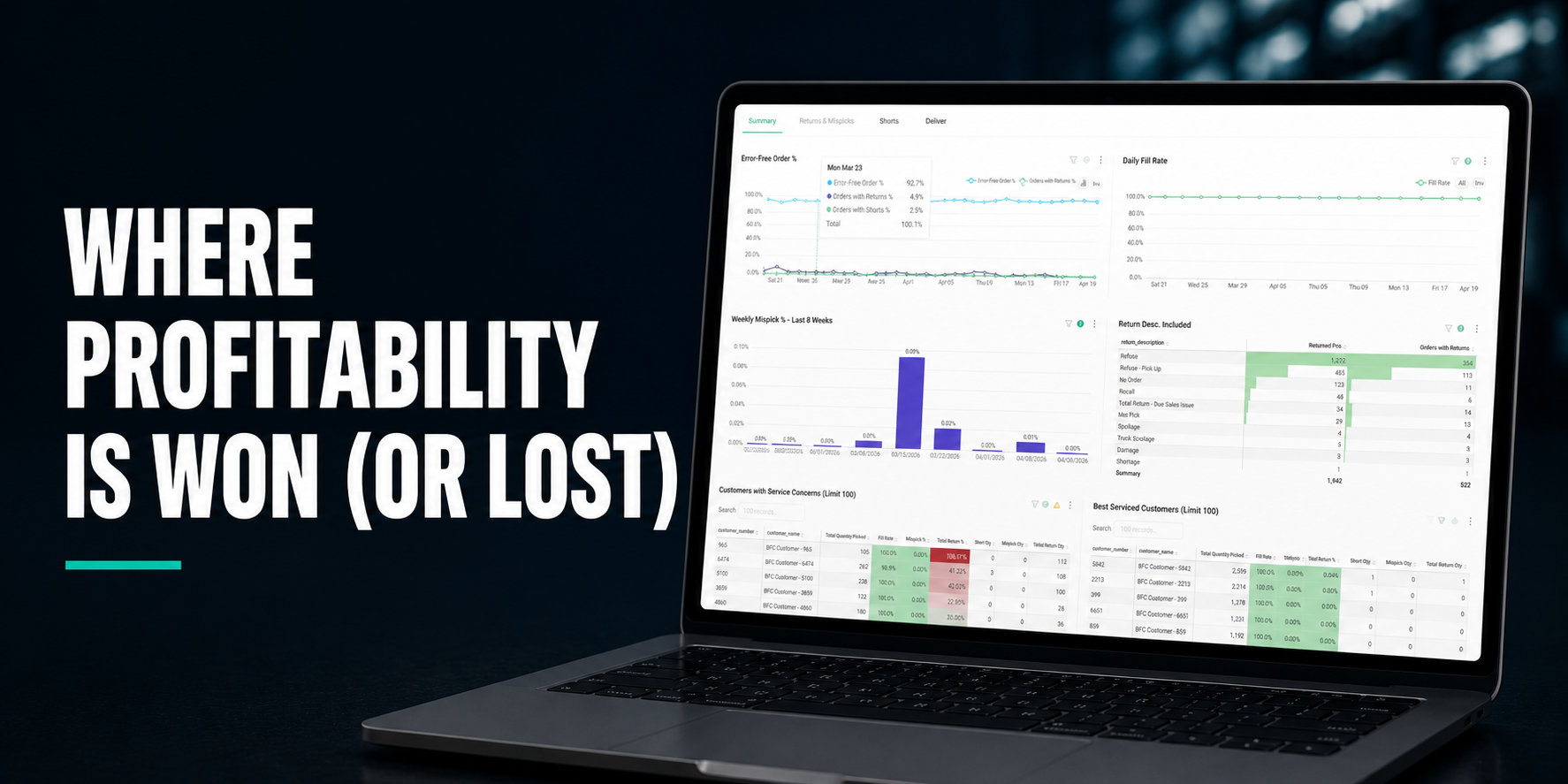
How Analytics is Transforming Profitability in Food Distribution Warehouses\
\
May 4, 2026
\
\
How Analytics is Transforming Profitability in Food Distribution Warehouses\
\
May 4, 2026
 \
\
6 Ways Food Distribution Warehouse Operations are Different\
\
April 21, 2026
\
\
6 Ways Food Distribution Warehouse Operations are Different\
\
April 21, 2026
 \
\
What a WMS Actually Does in Food Distribution (And Why Your ERP Can't Do It) \
\
April 1, 2026
\
\
What a WMS Actually Does in Food Distribution (And Why Your ERP Can't Do It) \
\
April 1, 2026
 \
\
Why Food Distributors Need a Food-Specific WMS (Not Just an ERP)\
\
December 17, 2025
\
\
Why Food Distributors Need a Food-Specific WMS (Not Just an ERP)\
\
December 17, 2025

 \
\
How to Measure Buying Team Performance in Food Distribution\
\
November 25, 2025
\
\
How to Measure Buying Team Performance in Food Distribution\
\
November 25, 2025
 \
\
Turning Efficiency into Profit: A New Playbook for Food Distributors\
\
November 13, 2025
\
\
Turning Efficiency into Profit: A New Playbook for Food Distributors\
\
November 13, 2025

.png)
 \
\
At BFC, We Speak IT and Food Distribution. Here’s How.\
\
May 2, 2024
\
\
At BFC, We Speak IT and Food Distribution. Here’s How.\
\
May 2, 2024
 \
\
3 Essential IT Strategies for Improving Food Distribution Operations\
\
April 19, 2024
\
\
3 Essential IT Strategies for Improving Food Distribution Operations\
\
April 19, 2024

 \
\
How BFC Empowers Executives to Drive Company Success\
\
April 19, 2024
\
\
How BFC Empowers Executives to Drive Company Success\
\
April 19, 2024
 \
\
Warehouse Managers, Is Your WMS Future-Proofing Your Food Distribution Business?\
\
May 2, 2024
\
\
Warehouse Managers, Is Your WMS Future-Proofing Your Food Distribution Business?\
\
May 2, 2024
\
\
The Invisible Bottlenecks- How Hidden Warehouse Challenges Are Costing You \
\
April 16, 2024
 \
\
BFC Attracts Strategic Investment from M33 Growth\
\
September 7, 2023
\
\
BFC Attracts Strategic Investment from M33 Growth\
\
September 7, 2023
 \
\
24/7/365: Why BFC Offers Round-the-Clock Support\
\
February 9, 2024
\
\
24/7/365: Why BFC Offers Round-the-Clock Support\
\
February 9, 2024
 \
\
The BFC Advantage: How Our Customers Outperform\
\
February 6, 2024
\
\
The BFC Advantage: How Our Customers Outperform\
\
February 6, 2024
